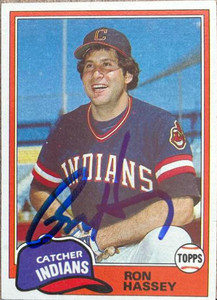


Ron Hassey Autographed 1982 Donruss #463 Cleveland Indians Card
$20.00
(No reviews yet)

Write a Review

Ron Hassey Autographed 1982 Donruss #463 Cleveland Indians Card
This Ron Hassey autographed 1982 Donruss #463 Cleveland Indians baseball card features the talented left-handed-hitting catcher during his tenure with Cleveland. Issued as part of Donruss' second annual baseball card collection, this hand-signed collectible celebrates an accomplished Major League catcher who enjoyed a 14-season career from 1978 through 1991 and earned a unique place in baseball history by catching two perfect games.
Ron Hassey, born February 27, 1953, in Tucson, Arizona, established himself as a dependable catcher known for his defensive abilities, knowledge of opposing hitters, and ability to work effectively with Major League pitching staffs.
Throughout his career, Hassey played for the Cleveland Indians, Chicago Cubs, New York Yankees, Chicago White Sox, Oakland Athletics, and Montreal Expos.
Although he was a capable offensive contributor, Hassey's greatest accomplishments came through his work behind the plate, where he developed a reputation for handling pitchers and guiding them through difficult situations.
His career included membership on three consecutive American League championship teams with the Oakland Athletics and participation in the organization's 1989 World Series championship.
Hassey began his professional baseball career after being selected by the Cleveland Indians in the 18th round of the 1976 Major League Baseball Draft.
He attended the University of Arizona, where he developed his catching abilities before beginning his professional career.
After progressing through Cleveland's minor league system, Hassey made his Major League debut on April 23, 1978.
He joined an Indians organization that featured several recognizable players during the late 1970s and early 1980s.
Cleveland's roster included players such as Andre Thornton, Rick Manning, Duane Kuiper, Toby Harrah, and Mike Hargrove during this period.
Hassey gradually established himself as an important member of the team's catching staff.
His ability to work with pitchers and contribute offensively helped him earn regular playing time.
The 1980 season became particularly memorable.
Hassey enjoyed one of the finest offensive seasons of his career, batting .318 for Cleveland.
His performance demonstrated that he could provide valuable production at the plate while continuing to handle the demanding responsibilities of catching.
However, the most significant moment of his 1980 season came on May 15, when he caught one of the most remarkable pitching performances in Major League Baseball history.
On that date, Cleveland Indians pitcher Len Barker threw a perfect game against the Toronto Blue Jays at Cleveland Stadium.
Barker retired all 27 Toronto batters without allowing a hit, walk, or baserunner.
Hassey was behind the plate for the entire performance, helping guide Barker through the historic achievement.
Cleveland defeated Toronto 3-0, and Barker's performance became the 10th perfect game in Major League Baseball history.
For Hassey, catching Barker's perfect game represented an extraordinary accomplishment.
The catcher's role in a perfect game extends beyond receiving pitches.
He must work with the pitcher to select pitches, study opposing hitters, maintain concentration, and help manage the pressure as the possibility of a historic achievement becomes increasingly apparent.
Hassey's contributions to Barker's performance established an important connection between his career and one of baseball's rarest individual accomplishments.
The 1981 season was shortened by the Major League Baseball players' strike, creating an unusual schedule for teams throughout the league.
Hassey continued serving as a catcher for Cleveland, providing experience and stability behind the plate.
By this point, he had become an established Major League player and a respected member of the Indians' roster.
The 1982 season represented another chapter in his Cleveland career.
Hassey continued contributing to the Indians as a catcher and left-handed hitter.
His offensive abilities made him particularly useful in a position traditionally associated with defense and game management.
Cleveland remained in the American League East during this period, competing against organizations such as the New York Yankees, Milwaukee Brewers, Baltimore Orioles, Boston Red Sox, Detroit Tigers, and Toronto Blue Jays.
Hassey's years with Cleveland helped establish the foundation for a lengthy Major League career.
During the middle of the 1980s, he continued his career with several organizations, including the Chicago Cubs, New York Yankees, and Chicago White Sox.
His experience and ability to handle pitching staffs made him a valuable addition to teams seeking dependable catching.
Hassey eventually joined the Oakland Athletics, beginning one of the most successful chapters of his career.
The Athletics were assembling a powerful roster under manager Tony La Russa, featuring stars such as Jose Canseco, Mark McGwire, Rickey Henderson, Dave Stewart, Dennis Eckersley, and Carney Lansford.
Oakland became one of the American League's strongest organizations during the late 1980s.
Hassey's veteran experience and catching abilities made him an important contributor to the team's pitching staff.
The 1988 season marked the beginning of a remarkable run of success for Oakland.
The Athletics captured the American League West Division championship and advanced to the postseason.
Oakland defeated the Boston Red Sox in the American League Championship Series before facing the Los Angeles Dodgers in the World Series.
Although the Dodgers won the championship, Oakland had established itself as one of baseball's premier teams.
The 1989 season brought another outstanding campaign.
The Athletics again captured the American League West championship and advanced to the postseason.
Oakland defeated the Toronto Blue Jays in the American League Championship Series, earning another trip to the World Series.
The Athletics faced the San Francisco Giants in the 1989 World Series, a matchup remembered as the Battle of the Bay.
The series became historically significant when the Loma Prieta earthquake struck Northern California on October 17, 1989, shortly before Game 3 was scheduled to begin.
The earthquake caused extensive damage throughout the Bay Area and resulted in the postponement of the World Series.
When play eventually resumed, Oakland completed a four-game sweep of San Francisco to capture the 1989 World Series championship.
Hassey was a member of the championship team, adding a World Series title to his career accomplishments.
The 1990 season provided another memorable chapter.
Oakland captured its third consecutive American League pennant, continuing its remarkable run of success.
The Athletics defeated the Boston Red Sox in the American League Championship Series before facing the Cincinnati Reds in the World Series.
Although Cincinnati swept Oakland, the Athletics' three consecutive pennants represented an impressive accomplishment.
Hassey's experience behind the plate continued to make him a valuable member of the organization.
The most remarkable individual achievement of his career came on July 28, 1991.
Pitching for the Montreal Expos against the Los Angeles Dodgers, Dennis Martinez threw a perfect game, retiring all 27 opposing batters.
Hassey was once again the catcher.
Montreal defeated Los Angeles 2-0, giving Martinez the first perfect game in Expos franchise history.
The achievement made Hassey the first catcher in Major League Baseball history to catch two perfect games.
His participation in both Len Barker's 1981 perfect game and Dennis Martinez's 1991 perfect game established a unique place for Hassey in baseball history.
Catching even one perfect game is an extraordinarily rare accomplishment.
Hassey's ability to guide two different pitchers, representing two different organizations, through perfect games separated by more than a decade remains one of the most distinctive achievements associated with a Major League catcher.
The performances also demonstrated the importance of the relationship between pitchers and catchers.
Both Barker and Martinez relied on Hassey's experience, preparation, and pitch selection during their historic outings.
For collectors interested in baseball's perfect games, Hassey's autograph carries a particularly compelling historical connection.
He concluded his Major League playing career in 1991, completing 14 seasons at baseball's highest level.
Over his career, Hassey collected more than 900 hits while establishing himself as a dependable catcher and experienced veteran.
His accomplishments included catching two perfect games, participating in three consecutive American League championship seasons with Oakland, and winning the 1989 World Series.
Although Hassey was never among baseball's most celebrated offensive stars, his defensive contributions and involvement in historic pitching performances made him an important figure in Major League history.
His connection to both Len Barker and Dennis Martinez provides a distinctive collecting theme for fans interested in the history of perfect games.
The 1982 Donruss baseball card collection represents an important release from the early years of Donruss' involvement in the baseball card industry.
Donruss entered the modern baseball card market in 1981, joining Fleer in challenging Topps' longtime dominance of the baseball card industry.
The arrival of Donruss and Fleer provided collectors with additional choices and helped transform the hobby into a more competitive marketplace.
The 1982 Donruss baseball card set was the company's second major baseball release and continued establishing Donruss as a recognizable manufacturer.
The collection featured 653 consecutively numbered player and manager cards, along with seven checklist cards, showcasing established Major League stars, accomplished veterans, promising young players, and recognizable figures from across professional baseball.
The set is remembered for its colorful borders, prominent player photography, and distinctive early-1980s appearance.
One of its notable features was the introduction of the Diamond Kings subset, which highlighted selected Major League players through illustrated artwork.
Diamond Kings would become one of the most recognizable features of Donruss baseball card collections throughout the 1980s and beyond.
The 1982 Donruss set also included the popular Cal Ripken Jr. rookie card, helping establish the collection as an important release among collectors of early-1980s baseball cards.
For collectors interested in complete signed sets, the 1982 Donruss collection provides an appealing opportunity to document a wide variety of players from an important period in Major League Baseball history.
Hassey's 1982 Donruss #463 features him as a member of the Cleveland Indians, documenting the early portion of his Major League career.
The card was issued less than a year after he caught Len Barker's historic May 15, 1981 perfect game, making it an especially appealing collectible for fans interested in that remarkable achievement.
It also predates Hassey's participation in Oakland's championship seasons and his second perfect game with Dennis Martinez in 1991.
For collectors assembling comprehensive Ron Hassey autograph collections, this Donruss issue provides an attractive example from his Cleveland years.
The classic early-1980s Donruss presentation makes it particularly appealing to collectors who appreciate traditional baseball card designs.
Cleveland Indians collectors will appreciate the card's connection to Barker's perfect game and the team's early-1980s roster.
Oakland Athletics collectors may also find the card appealing because of Hassey's contributions to the organization's successful teams during the late 1980s, including the 1989 World Series championship.
Montreal Expos collectors will recognize his historic role in Dennis Martinez's 1991 perfect game.
For collectors working toward a complete autographed 1982 Donruss baseball card set, Hassey represents an accomplished Major League catcher whose signature adds considerable historical appeal to the collection.
The combination of the classic 1982 Donruss design, Hassey's Cleveland Indians appearance, his participation in two perfect games, his World Series championship, and his authentic hand-signed autograph makes this collectible an attractive addition to baseball card and autograph collections.
This signed card is an excellent addition to any Cleveland Indians memorabilia collection, Ron Hassey autograph collection, 1982 Donruss signed baseball card set, Len Barker perfect game collection, Dennis Martinez perfect game collection, Oakland Athletics 1989 World Series championship collection, Montreal Expos memorabilia collection, or assortment of autographed baseball cards featuring accomplished Major League catchers.
Condition: NM-MT or better.
The autograph was obtained through a private signing conducted by Under the Radar Sports Promotions and is guaranteed to pass any third-party authentication service.