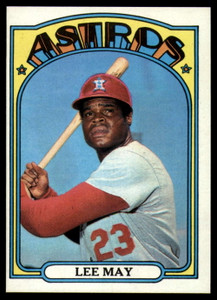


Lee May Autographed 1973 Topps #135 Houston Astros Card
$100.00
(No reviews yet)

Write a Review

Lee May Autographed 1973 Topps #135 Houston Astros Card
The Lee May Autographed 1973 Topps #135 Houston Astros Card features one of the National League's most formidable power hitters of the late 1960s and early 1970s. Nicknamed "The Big Bopper," May enjoyed an outstanding 18-season Major League career with the Cincinnati Reds, Houston Astros, Baltimore Orioles, and Kansas City Royals. A three-time All-Star and one of the most consistent run producers of his generation, May finished his career with 354 home runs, 1,244 RBI, and 2,031 hits.
Known for his tremendous right-handed power, May was a central figure in the Cincinnati Reds' rise to prominence before becoming an important offensive presence with the Houston Astros. He later helped the Baltimore Orioles reach the 1979 World Series and completed his career as a member of the 1985 World Series champion Kansas City Royals.
The 1973 Topps #135 captures May during his early years with Houston, following the blockbuster trade that brought him to the Astros from Cincinnati. The card represents an important chapter in the career of one of baseball's most accomplished power hitters of the era.
Lee Andrew May was born on March 23, 1943, in Birmingham, Alabama.
May signed with the Cincinnati Reds organization in 1961, beginning a professional baseball career that would eventually span more than two decades.
He developed into a powerful right-handed hitter while advancing through Cincinnati's minor league system.
May made his Major League debut with the Reds on September 1, 1965.
After gaining experience during his early appearances, he became a regular member of Cincinnati's lineup in 1967.
His powerful swing and ability to drive in runs quickly established him as one of the team's most promising offensive players.
May enjoyed his first major breakthrough during the 1968 season, hitting 22 home runs with 80 RBI.
He followed that performance with an outstanding 1969 campaign, batting .278 with 38 home runs and 110 RBI.
His 38 home runs established a career high and earned him his first National League All-Star selection.
May's emergence helped strengthen a Cincinnati lineup that was developing into one of baseball's most dangerous offensive units.
The 1970 season became one of the most memorable years of his career.
Playing alongside future Hall of Famers Johnny Bench and Tony Prez, as well as stars such as Pete Rose and Bobby Tolan, May helped the Reds capture the National League West championship.
Cincinnati finished with a 102-60 record and advanced to the postseason.
The Reds defeated the Pittsburgh Pirates in the National League Championship Series, capturing the National League pennant.
May played an important role in Cincinnati's offensive success, hitting 34 home runs with 94 RBI during the regular season.
The Reds advanced to the 1970 World Series against the Baltimore Orioles.
Although Baltimore won the championship in five games, May delivered an exceptional individual performance.
He batted .389 with two home runs and eight RBI during the series, demonstrating his ability to produce against outstanding postseason pitching.
His performance remains one of the notable individual offensive achievements from that World Series.
May continued his success in 1971, hitting 39 home runs and driving in 98 runs.
His 39 home runs represented a new career high, and he earned another National League All-Star selection.
Despite his offensive accomplishments, Cincinnati was preparing to make a major roster change.
Following the 1971 season, the Reds traded May, second baseman Tommy Helms, and infielder Jimmy Stewart to the Houston Astros in exchange for Joe Morgan, Csar Gernimo, Ed Armbrister, Jack Billingham, and Denis Menke.
The transaction became one of the most consequential trades in baseball history.
Morgan and Gernimo would become essential members of Cincinnati's legendary Big Red Machine teams, while May and Helms provided Houston with established Major League talent.
For May, the trade marked the beginning of a productive three-season tenure with the Astros.
Houston featured talented players such as Jimmy Wynn, Csar Cedeo, Bob Watson, Doug Rader, and Don Wilson during this period.
May immediately became an important part of the Astros' offense.
During the 1972 season, he hit 29 home runs with 98 RBI, providing Houston with the powerful right-handed bat the organization had sought.
His production was especially impressive considering that the Astros played their home games in the Astrodome, a ballpark widely regarded as difficult for home-run hitters.
May's ability to generate power in that environment reinforced his reputation as one of the National League's premier sluggers.
The 1973 Topps #135 features May following his first season in Houston.
The 1973 Topps baseball set contains 660 cards and is remembered for its classic early-1970s design.
The cards feature prominent player photography, colorful team identification, and a distinctive position silhouette in the lower corner.
The set includes numerous Hall of Famers, established stars, and memorable rookie cards, making it popular among vintage baseball card collectors.
May's #135 card features him in his Houston Astros uniform, representing an important period in his career.
The card is particularly appealing because it captures May shortly after his arrival in Houston and during a period when he remained one of the National League's most productive power hitters.
May continued providing strong offensive production during the 1973 season, hitting 28 home runs with 105 RBI.
His ability to drive in runs made him an important presence in the middle of Houston's batting order.
He followed that performance with another productive campaign in 1974, hitting 24 home runs with 85 RBI.
Following the 1974 season, May was traded to the Baltimore Orioles, beginning another successful chapter of his career.
Baltimore was one of the American League's most respected organizations, led by legendary manager Earl Weaver.
The Orioles featured outstanding players such as Jim Palmer, Brooks Robinson, Mark Belanger, and Bobby Grich.
May provided Baltimore with a powerful right-handed hitter capable of producing runs in the middle of the lineup.
During the 1976 season, he led the American League with 109 RBI, earning the league's RBI championship.
His ability to deliver in run-producing situations made him one of Baltimore's most valuable offensive players.
May remained an important member of the Orioles throughout the late 1970s.
In 1979, Baltimore captured the American League East championship and advanced to the postseason.
The Orioles defeated the California Angels in the American League Championship Series to win the pennant.
Baltimore then faced the Pittsburgh Pirates in the 1979 World Series.
Although the Orioles held a three-games-to-one lead, Pittsburgh rallied to win the championship in seven games.
May's participation in the series marked his second World Series appearance, following his earlier experience with Cincinnati in 1970.
He continued playing for Baltimore through the 1980 season before joining the Kansas City Royals.
May spent the final seasons of his Major League career with Kansas City, serving as an experienced veteran and designated hitter.
He completed his playing career in 1982, finishing with 354 home runs, 1,244 RBI, 2,031 hits, and a .267 batting average.
His 354 home runs placed him among the most accomplished power hitters of his generation.
May's achievements included three All-Star selections, an American League RBI title, and appearances in two World Series.
Although he never won a World Series championship as a player, his offensive production and longevity established him as one of baseball's respected sluggers of the 1960s and 1970s.
Following his playing career, May remained involved in professional baseball as a coach and instructor.
He served as a hitting coach with the Kansas City Royals and was part of the coaching staff when Kansas City captured the 1985 World Series championship.
That achievement provided May with a World Series championship connection after his two previous appearances as a player.
May passed away on July 29, 2017, at the age of 74.
His legacy remains particularly meaningful to fans of the Cincinnati Reds, Houston Astros, and Baltimore Orioles.
For Cincinnati fans, May is remembered as one of the powerful hitters who helped establish the foundation for the Big Red Machine.
For Houston Astros fans, he represents an important part of the organization's early-1970s history, when the club was developing a lineup capable of competing in the National League West.
For Baltimore Orioles fans, May remains associated with the successful teams of the late 1970s, including the 1979 American League championship club.
For collectors, the 1973 Topps #135 represents May during his Houston Astros years, when he continued demonstrating the power and run production that defined his career.
The card's classic 1973 Topps design, Houston Astros uniform, three All-Star selections, and connection to one of baseball's most productive power hitters make it an appealing vintage autograph.
The Lee May Autographed 1973 Topps #135 Houston Astros Card is an excellent collectible for Houston Astros fans, Cincinnati Reds Big Red Machine memorabilia collectors, Baltimore Orioles enthusiasts, vintage power hitter autograph collections, American League RBI leader collections, Lee May memorabilia collectors, 1973 Topps baseball card collectors, and hobbyists assembling complete autographed 1973 Topps baseball card sets.
Autograph Guarantee: Signature obtained through a private signing conducted by Under the Radar Sports Promotions and guaranteed to pass any third-party authentication service.