
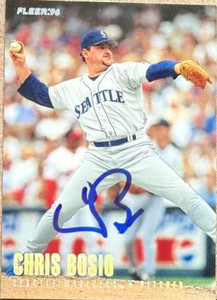

Chris Bosio Autographed 1996 Fleer #229 Seattle Mariners Card
$40.00
(No reviews yet)

Write a Review
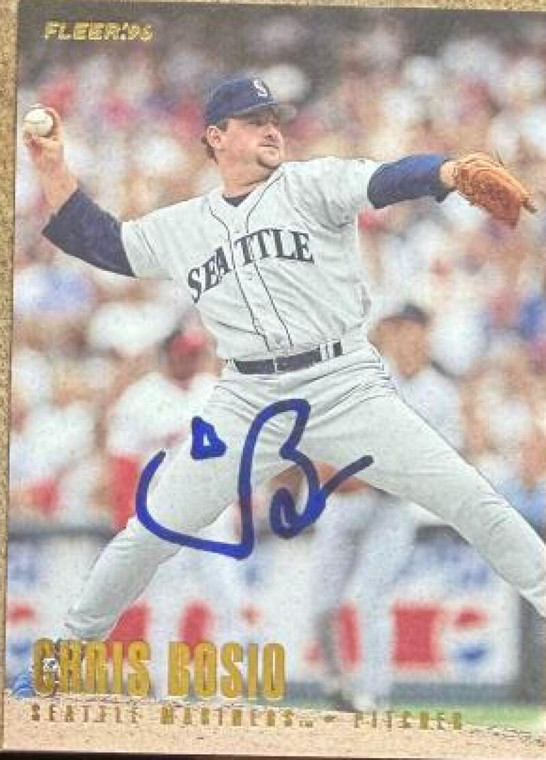
Chris Bosio Autographed 1996 Fleer #229 Seattle Mariners Card
The Chris Bosio Autographed 1996 Fleer #229 Seattle Mariners Card features the veteran right-handed pitcher who made baseball history by throwing a no-hitter against the Boston Red Sox on April 22, 1993. A dependable Major League starter who spent 11 seasons with the Milwaukee Brewers and Seattle Mariners, Bosio later became the pitching coach of the Chicago Cubs, helping the organization capture its historic 2016 World Series championship.
This autographed card comes from the 1996 Fleer baseball set, a memorable release that marked a significant departure from the glossy, heavily stylized baseball cards that dominated much of the early 1990s. Fleer introduced a distinctive matte-finish presentation for its 1996 flagship product, giving the cards a more traditional appearance while maintaining the photography and design elements associated with the company's established baseball card line.
The 1996 Fleer #229 features Bosio with the Seattle Mariners during the final season of his Major League playing career. The card was issued following Seattle's remarkable 1995 campaign, when the Mariners captured their first American League West championship and advanced to the postseason for the first time in franchise history.
Bosio had already secured his place in Seattle baseball history through his unforgettable 1993 no-hitter. His appearance in the 1996 Fleer set documents the closing chapter of a playing career that included 94 Major League victories, more than 1,000 strikeouts, and one of the most impressive individual pitching performances in Mariners history.
Featuring Bosio's authentic handwritten autograph, this card combines a recognizable 1990s Fleer baseball release with the signature of a pitcher whose professional career connected him to memorable moments in Milwaukee Brewers, Seattle Mariners, and Chicago Cubs history.
Chris Bosio's Early Career with the Milwaukee Brewers
Christopher Louis Bosio was born on April 3, 1963, in Carmichael, California. He began his professional baseball career after the Milwaukee Brewers selected him in the second round of the 1982 Major League Baseball Draft.
Bosio developed through Milwaukee's minor league system, establishing himself as a pitcher who relied on command, movement, and the ability to keep opposing hitters off balance.
He made his Major League debut on August 3, 1986, beginning a seven-season tenure with the Brewers.
Milwaukee featured several prominent players during Bosio's early years, including future Hall of Famers Robin Yount and Paul Molitor.
The 1987 Brewers opened the season with 13 consecutive victories, producing one of the most memorable winning streaks in franchise history.
Bosio continued developing into a dependable Major League starting pitcher throughout the late 1980s.
During the 1988 season, he compiled a 13-8 record with a 3.36 ERA, establishing himself as an important contributor to Milwaukee's starting rotation.
The following year, Bosio recorded 15 victories in 1989, the highest single-season win total of his Major League career.
His effectiveness came from his ability to locate pitches, change speeds, and induce hitters to make contact on his terms.
Rather than depending exclusively on overpowering velocity, Bosio developed into a pitcher who understood how to work through opposing lineups and make adjustments throughout a game.
He remained a valuable member of Milwaukee's pitching staff through the early 1990s.
The Brewers featured a talented roster that included Robin Yount, Paul Molitor, B.J. Surhoff, Greg Vaughn, and Jim Gantner.
The 1992 Milwaukee Brewers finished with a 92-70 record, placing second in the American League East behind the eventual World Series champion Toronto Blue Jays.
Milwaukee finished only four games behind Toronto, remaining in contention throughout the season.
Following the 1992 campaign, Bosio joined the Seattle Mariners, beginning the second chapter of his Major League career.
Seattle was assembling an exciting roster featuring Ken Griffey Jr., Edgar Martnez, Jay Buhner, and Randy Johnson.
Bosio brought valuable starting pitching experience to the Mariners and would soon deliver one of the greatest individual performances in franchise history.
The Historic April 22, 1993 No-Hitter
The defining accomplishment of Bosio's Major League playing career occurred on April 22, 1993, when he faced the Boston Red Sox at the Kingdome in Seattle.
Bosio delivered an extraordinary performance, throwing a no-hitter in a 7-0 Mariners victory.
The game began in unusual fashion.
Bosio walked Boston's first two batters, placing runners on base before recording an out.
After those opening walks, however, he settled into an exceptional rhythm.
Bosio proceeded to retire the final 27 consecutive Boston hitters, preventing another Red Sox player from reaching base.
His performance made him the second pitcher in Seattle Mariners history to throw a no-hitter, following Randy Johnson's achievement against the Detroit Tigers in 1990.
The accomplishment was especially memorable because of the contrast between the difficult opening and the remarkable command Bosio demonstrated throughout the remainder of the game.
Retiring 27 consecutive batters required exceptional concentration, consistency, and execution.
The no-hitter immediately established Bosio as an important figure in Mariners pitching history.
For Seattle fans, the performance remains one of the most memorable individual accomplishments from the franchise's early decades.
The 1996 Fleer #229 is particularly appealing because it features Bosio with Seattle only three seasons after his historic achievement.
His authentic autograph adds a direct personal connection to the pitcher responsible for one of the organization's defining performances.
The 1996 Fleer Baseball Card Set
The 1996 Fleer baseball set represents a distinctive chapter in the history of one of baseball card collecting's most recognizable manufacturers.
Fleer entered the modern baseball card market in 1981, joining Topps and Donruss as one of the principal companies producing nationally distributed baseball card sets.
Throughout the 1980s, Fleer developed a loyal following among collectors through its annual flagship releases, distinctive photography, and memorable player checklists.
The company continued expanding its product lineup during the early 1990s, introducing premium brands such as Fleer Ultra, Flair, and E-Motion.
These products emphasized glossy finishes, specialty printing techniques, and increasingly sophisticated designs.
By the middle of the decade, the baseball card market had become crowded with premium products and elaborate inserts.
For its 1996 flagship baseball release, Fleer adopted a noticeably different approach.
The cards featured a matte-style finish, giving the product a more traditional feel than many of the glossy premium cards available during the same period.
This design decision helped distinguish the 1996 Fleer set from other contemporary releases.
The finish also became one of the defining characteristics collectors associate with the product.
Rather than emphasizing metallic surfaces or elaborate foil treatments throughout the base set, Fleer presented a design that placed greater attention on the players and their photographs.
The result was a recognizable release that stood apart from many other baseball card products of the era.
The 1996 Fleer #229 Chris Bosio is part of the regular flagship checklist.
It features Bosio with the Seattle Mariners during the final season of his Major League playing career.
For collectors who pursue comprehensive player collections, regular flagship issues remain an important foundation.
These cards document players across different seasons and provide a record of their careers through the designs of individual manufacturers.
The 1996 Fleer release is particularly interesting because of its distinctive presentation.
Throughout the early 1990s, manufacturers had increasingly emphasized glossy coatings, premium finishes, and specialty printing techniques.
Fleer's decision to use a matte-style presentation provided an alternative that appealed to collectors who appreciated a more traditional baseball card appearance.
The release also arrived during an important period of change within Major League Baseball.
The 1994 players' strike had disrupted the sport, and the 1995 season marked baseball's return following the cancellation of the previous year's World Series.
By 1996, Major League Baseball was entering a new period, with established stars continuing their careers and younger players beginning to emerge.
For Seattle Mariners collectors, the 1996 Fleer set holds additional significance because it followed the franchise's first postseason appearance.
The Mariners had become one of the American League's most exciting teams, led by Ken Griffey Jr., Edgar Martnez, Randy Johnson, and Jay Buhner.
Bosio's inclusion in the set documents his association with the organization during this memorable period.
A Distinctive 1990s Fleer Release
The 1996 Fleer baseball set remains recognizable among collectors because of its departure from the premium presentation that had become increasingly common throughout the hobby.
During the late 1980s and early 1990s, baseball card manufacturers introduced numerous innovations designed to attract collectors.
Upper Deck helped popularize premium photography and sophisticated production techniques beginning in 1989.
Other manufacturers responded by developing additional premium products.
Fleer expanded its lineup through several recognizable brands, including Ultra, Flair, and E-Motion.
Each offered collectors a different approach to baseball card presentation.
The traditional Fleer flagship set continued providing a broad selection of Major League players.
In 1996, the company's matte-style design gave the flagship product an identity distinct from its premium offerings.
For collectors who grew up during the 1990s, the set remains a recognizable example of a period when manufacturers were experimenting with different finishes and designs.
The Chris Bosio #229 represents this distinctive release while documenting the final stage of his Major League playing career.
The card's association with the Seattle Mariners adds historical interest because of the team's breakthrough 1995 season.
Bosio's authentic handwritten autograph further distinguishes the collectible.
For collectors who pursue autographed versions of regular flagship cards, this issue provides another opportunity to expand a comprehensive Chris Bosio collection.
The combination of a recognizable Fleer design, an important Seattle Mariners player, and an authentic autograph makes the card appealing to collectors interested in both 1990s baseball cards and Major League pitching history.
The Historic 1995 Seattle Mariners Season
The 1995 Major League Baseball season followed the players' strike that began in August 1994 and resulted in the cancellation of that year's World Series.
Baseball resumed in 1995 with a shortened regular-season schedule.
For the Seattle Mariners, however, the season would become one of the most important in franchise history.
Seattle entered the year with a talented roster featuring some of the most recognizable players in Major League Baseball.
Ken Griffey Jr. had established himself as one of the game's premier superstars, combining outstanding offensive production with exceptional defensive ability in center field.
Edgar Martnez was among the American League's most accomplished hitters, while Jay Buhner provided significant power in Seattle's lineup.
Randy Johnson had developed into one of baseball's most intimidating pitchers and would enjoy an outstanding 1995 campaign.
Bosio contributed veteran experience to a pitching staff preparing to help the Mariners accomplish something the franchise had never achieved.
Seattle remained in contention throughout the season and ultimately finished tied with the California Angels for first place in the American League West.
The division championship was decided in a one-game playoff on October 2, 1995.
The Mariners defeated California 9-1, with Randy Johnson delivering an outstanding pitching performance.
The victory gave Seattle its first American League West championship and first postseason appearance in franchise history.
For a team that had entered Major League Baseball as an expansion franchise in 1977, the accomplishment represented a tremendous milestone.
Seattle advanced to the American League Division Series against the New York Yankees.
After losing the first two games in New York, the Mariners faced elimination as the series moved to Seattle.
The team responded by winning three consecutive games, completing one of the most memorable postseason comebacks in baseball history.
The decisive fifth game produced a moment that remains legendary among Mariners fans.
With Seattle trailing in the bottom of the 11th inning, Edgar Martnez hit a two-run double, scoring Joey Cora and Ken Griffey Jr. to give the Mariners a dramatic victory.
The play became known as "The Double" and remains one of the defining moments in Seattle sports history.
The Mariners advanced to the American League Championship Series before losing to the Cleveland Indians in six games.
Although Seattle did not reach the World Series, the team's remarkable postseason run helped establish the franchise as an important American League contender.
The season also strengthened the connection between the Mariners and their fans, becoming a defining chapter in the history of professional baseball in the Pacific Northwest.
For collectors, baseball cards featuring members of the 1995 Seattle Mariners provide a connection to this historic campaign.
Bosio's 1996 Fleer #229 documents his career immediately following that memorable season.
Bosio's Final Major League Season in 1996
The 1996 season marked the conclusion of Bosio's Major League playing career.
By this point, he had established himself as a veteran pitcher with extensive experience in both Milwaukee and Seattle.
His accomplishments included a career-high 15 victories with the Brewers in 1989 and his unforgettable 1993 no-hitter against Boston.
Bosio had also witnessed the Mariners' transformation from a developing franchise into an American League contender.
The organization's 1995 postseason run represented a major turning point in Seattle baseball history.
Although Bosio's playing career concluded in 1996, his association with professional baseball continued through coaching and player development.
Across 11 Major League seasons, he compiled a 94-93 record, 3.96 ERA, and 1,059 strikeouts.
His career reflected the value of pitching experience, command, and the ability to compete against Major League hitters over an extended period.
The 1996 Fleer #229 is therefore an appealing late-career collectible for fans interested in documenting the complete playing career of Chris Bosio.
The 2016 Chicago Cubs World Series Championship
Following his retirement as a player, Bosio continued working in professional baseball through coaching and player development.
His understanding of pitching mechanics, command, and game preparation helped him transition into an instructional role.
Bosio eventually became the pitching coach for the Chicago Cubs, contributing to one of the most celebrated championship seasons in Major League Baseball history.
In 2016, the Cubs captured the National League pennant and advanced to the World Series against the Cleveland Indians.
After falling behind three games to one, Chicago rallied to force a decisive seventh game.
The Cubs ultimately won the championship, ending a 108-year World Series title drought dating back to 1908.
The victory became one of the most memorable moments in baseball history.
Bosio's work with the Cubs' pitching staff connected him to a championship celebrated by generations of baseball fans.
His role with the 2016 team added another significant accomplishment to a professional career that had already included a Major League no-hitter.
For collectors, Bosio's career provides connections to multiple important periods in baseball history, including Milwaukee's competitive teams of the late 1980s, Seattle's emergence during the 1990s, and Chicago's historic championship in 2016.
Collecting the Chris Bosio Autographed 1996 Fleer #229
For Milwaukee Brewers collectors, Bosio remains a recognizable pitcher from the organization's competitive late-1980s and early-1990s teams.
For Seattle Mariners fans, his April 22, 1993 no-hitter remains the defining accomplishment of his playing career.
For Chicago Cubs enthusiasts, his connection to the historic 2016 World Series championship provides another reason to appreciate his place in baseball history.
The 1996 Fleer #229 is particularly appealing because it combines a distinctive matte-finish Fleer baseball card with a player who achieved one of the most memorable pitching performances in Seattle Mariners history.
Its connection to the Mariners' breakthrough 1995 season and Bosio's final Major League campaign adds historical interest for collectors assembling comprehensive player collections.
The Chris Bosio Autographed 1996 Fleer #229 Seattle Mariners Card is an excellent collectible for Seattle Mariners fans, Milwaukee Brewers memorabilia collectors, Major League no-hitter autograph enthusiasts, Chicago Cubs World Series memorabilia collectors, Chris Bosio player collections, 1990s baseball card enthusiasts, Fleer flagship set collectors, and hobbyists assembling complete autographed 1996 Fleer baseball card sets.
Autograph Guarantee: Signature obtained through a private signing conducted by Under the Radar Sports Promotions and guaranteed to pass any third-party authentication service.


