
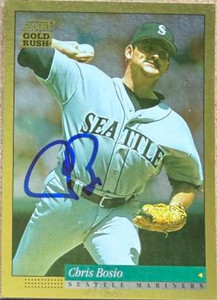

Chris Bosio Autographed 1994 Score Gold Rush #316 Seattle Mariners Card
$40.00
(No reviews yet)

Write a Review

Chris Bosio Autographed 1994 Score Gold Rush #316 Seattle Mariners Card
The Chris Bosio Autographed 1994 Score Gold Rush #316 Seattle Mariners Card features the veteran right-handed pitcher who spent 11 seasons in Major League Baseball with the Milwaukee Brewers and Seattle Mariners. Best remembered for throwing a no-hitter against the Boston Red Sox on April 22, 1993, Bosio established himself as a dependable American League starting pitcher before later serving as pitching coach for the 2016 World Series champion Chicago Cubs.
This autographed card comes from the 1994 Score Gold Rush parallel set, a distinctive variation of Score's popular 1994 baseball card release. Featuring a special gold foil treatment, the Gold Rush cards offered collectors an alternative to the standard Score issues and reflected the growing popularity of parallel baseball cards during the early 1990s.
The 1994 Score Gold Rush #316 features Bosio with the Seattle Mariners during the period immediately following his historic no-hitter. Its combination of a recognizable Score design, gold foil accents, and Bosio's authentic signature makes it an appealing collectible for Mariners fans and enthusiasts of 1990s baseball card parallels.
Unlike the regular 1994 Score #316, the Gold Rush parallel incorporates a distinctive gold foil treatment that identifies it as part of Score's specialty parallel release. These variations became an increasingly important part of baseball card collecting during the decade, offering collectors additional versions of their favorite players without changing the underlying card number.
For collectors assembling comprehensive Chris Bosio collections, the Gold Rush issue represents a separate variation from the regular Score card and provides another way to document his Seattle Mariners playing career.
Christopher Louis Bosio was born on April 3, 1963, in Carmichael, California. His professional baseball career began when the Milwaukee Brewers selected him in the second round of the 1982 Major League Baseball Draft.
Bosio developed through Milwaukee's minor league system, refining the command, pitch movement, and ability to change speeds that would become important elements of his success as a Major League pitcher.
He made his Major League debut on August 3, 1986, beginning a seven-season tenure with the Brewers.
Milwaukee featured several prominent players during Bosio's early years, including future Hall of Famers Robin Yount and Paul Molitor.
The 1987 Brewers produced one of the most memorable starts in franchise history, opening the season with 13 consecutive victories.
The remarkable winning streak generated tremendous excitement among Milwaukee baseball fans and remains an important part of the team's history.
Bosio continued developing into a dependable Major League starting pitcher throughout the late 1980s.
Rather than relying exclusively on overpowering velocity, his pitching approach emphasized command, movement, and keeping opposing hitters off balance.
During the 1988 season, Bosio compiled a 13-8 record with a 3.36 ERA, establishing himself as an important contributor to Milwaukee's starting rotation.
The following season brought another significant accomplishment.
In 1989, Bosio recorded 15 victories, the highest single-season win total of his Major League career.
His performance demonstrated his ability to provide consistent starting pitching against American League competition.
Throughout his time in Milwaukee, Bosio became a familiar member of the Brewers' pitching staff and contributed to teams featuring some of the organization's most recognizable players.
He remained with Milwaukee through the 1992 season, playing alongside Robin Yount, Paul Molitor, B.J. Surhoff, Greg Vaughn, and Jim Gantner.
The 1992 Brewers enjoyed one of the organization's strongest seasons of the decade.
Milwaukee finished with a 92-70 record, placing second in the American League East behind the eventual World Series champion Toronto Blue Jays.
The Brewers finished only four games behind Toronto, remaining competitive throughout the season.
Following the 1992 campaign, Bosio joined the Seattle Mariners, beginning the second chapter of his Major League playing career.
Seattle featured an exciting collection of players, including Ken Griffey Jr., Edgar Martnez, Jay Buhner, and Randy Johnson.
The Mariners were assembling a roster that would eventually transform the organization into a serious American League contender.
Bosio brought valuable experience to Seattle's starting rotation, providing another established pitcher for the developing club.
His move to Seattle proved especially significant because the 1993 season would produce the defining accomplishment of his Major League career.
On April 22, 1993, Bosio took the mound against the Boston Red Sox at the Kingdome in Seattle.
What followed became one of the most remarkable pitching performances in Mariners history.
Bosio threw a no-hitter, leading Seattle to a 7-0 victory over Boston.
The accomplishment was particularly memorable because the game began with two consecutive walks.
Bosio walked the first two Boston hitters, creating an early scoring opportunity for the Red Sox.
Rather than allowing the difficult beginning to disrupt his performance, Bosio settled into an extraordinary rhythm.
Following those opening walks, he retired the final 27 consecutive batters, preventing another Boston player from reaching base.
The performance made him the second pitcher in Seattle Mariners history to throw a no-hitter, following Randy Johnson's no-hitter against the Detroit Tigers in 1990.
Retiring 27 consecutive hitters after walking the first two batters required exceptional command, concentration, and consistency.
The achievement immediately established Bosio as an important part of Seattle's pitching history.
For Mariners fans, the no-hitter remains one of the defining individual accomplishments of the organization's early years.
The 1994 Score Gold Rush #316 is particularly appealing because it features Bosio during the season immediately following that historic performance.
Rather than documenting his earlier years with Milwaukee, the card represents his established role with the Mariners after he had already secured his place in franchise history.
The 1994 Score baseball release continued the tradition established when Score entered the baseball card market in 1988.
Score's inaugural release made a significant impression on collectors through its colorful designs, extensive player information, and photography-focused presentation.
The company quickly developed a following among baseball card enthusiasts who appreciated the combination of attractive designs and comprehensive Major League coverage.
During its early years, Score became particularly recognizable for including detailed player biographies and statistics, giving collectors additional information about the athletes featured on its cards.
The brand also developed a reputation for producing memorable rookie cards and featuring emerging Major League talent.
By 1994, Score had become an established part of the baseball card industry.
The 1994 Score Gold Rush parallels added another dimension to the company's baseball card offerings.
These special cards incorporated a gold foil treatment that made them visually distinct from their regular counterparts.
The Gold Rush concept reflected the growing popularity of parallel collecting, which had become an increasingly important part of the hobby during the early 1990s.
Rather than introducing an entirely unrelated card design, the Gold Rush parallels offered alternate versions of cards from the regular Score release.
The Chris Bosio Gold Rush #316 corresponds to his standard 1994 Score #316, allowing collectors to pursue both versions as part of a comprehensive player collection.
For enthusiasts who collect parallel variations, the Gold Rush issue provides an important distinction from the standard card.
The gold foil treatment gives the card a recognizable appearance that reflects Score's approach to specialty baseball card products during the period.
The use of gold-colored finishes became particularly popular during the early 1990s.
Several manufacturers introduced gold parallels and specialty cards, giving collectors additional opportunities to pursue their favorite players in multiple formats.
Score's Gold Rush cards became part of this trend, offering a visually distinctive parallel variation.
The 1994 Score Gold Rush release reflects the growing importance of parallel collecting during the decade.
Collectors could pursue their favorite players in multiple versions of the same basic card design, each offering a different visual presentation.
For comprehensive player collectors, these variations became important additions to individual checklists.
Bosio's Gold Rush #316 represents a distinctive parallel from the season immediately following his historic no-hitter.
By 1994, he had already established himself as a reliable Major League pitcher and had achieved the defining accomplishment of his career.
His inclusion in the Gold Rush parallel release provides collectors with another card documenting his Seattle Mariners years.
For collectors assembling comprehensive Chris Bosio player collections, the 1994 Score Gold Rush issue offers an attractive alternative to the regular Score card.
The 1994 release also represents an unusual period in Major League Baseball history.
The 1994 players' strike began in August, interrupting the regular season and ultimately resulting in the cancellation of the World Series.
The work stoppage became one of the most significant events in modern baseball history.
For collectors, cards from the 1994 season provide a reminder of the players and teams competing during that memorable period.
The Seattle Mariners were among the organizations assembling a talented roster that would help shape American League baseball during the middle of the decade.
Ken Griffey Jr. had become one of baseball's most recognizable superstars, combining tremendous offensive production with outstanding defensive ability in center field.
Edgar Martnez was developing into one of the American League's most accomplished hitters, while Jay Buhner provided significant power in Seattle's lineup.
Randy Johnson had established himself as one of baseball's most intimidating pitchers.
Bosio contributed experience and starting pitching depth, helping the organization develop into a legitimate contender.
Together, these players helped establish the foundation for one of the most memorable periods in Mariners history.
The 1995 season became a turning point for the organization.
Seattle finished the regular season tied with the California Angels for first place in the American League West.
The Mariners defeated California in a one-game playoff, claiming the division championship and earning the first postseason appearance in franchise history.
Seattle advanced to the American League Division Series against the New York Yankees.
After losing the first two games, the Mariners rallied to win three consecutive contests.
The decisive fifth game produced one of the most celebrated moments in franchise history.
In the bottom of the 11th inning, Edgar Martnez hit a two-run double, scoring Joey Cora and Ken Griffey Jr. to give Seattle a dramatic victory.
The play became one of the defining moments in Mariners history and helped establish the team as one of baseball's most exciting clubs.
Seattle advanced to the American League Championship Series before losing to the Cleveland Indians in six games.
Although the Mariners did not reach the World Series, the 1995 postseason run represented an important turning point for professional baseball in Seattle.
Bosio remained with the Mariners through the 1996 season, completing his Major League playing career.
Across 11 seasons, he compiled a 94-93 record, 3.96 ERA, and 1,059 strikeouts.
His accomplishments included a career-high 15 victories with Milwaukee in 1989, his historic 1993 no-hitter against Boston, and his association with Seattle during its first postseason appearance in 1995.
Following his retirement as a player, Bosio continued his professional baseball career through coaching and player development.
His understanding of pitching mechanics, command, and game preparation helped him transition into an instructional role.
Bosio eventually became the pitching coach for the Chicago Cubs, contributing to one of the most celebrated championship seasons in Major League Baseball history.
In 2016, the Cubs captured the National League pennant and advanced to the World Series against the Cleveland Indians.
After falling behind three games to one, Chicago rallied to force a decisive seventh game.
The Cubs ultimately won the championship, ending a 108-year World Series title drought dating back to 1908.
The victory became one of the most memorable moments in baseball history.
Bosio's work with the Cubs' pitching staff connected him to a championship celebrated by generations of baseball fans.
His role with the 2016 team added another significant accomplishment to a professional career that had already included a Major League no-hitter.
For Milwaukee Brewers collectors, Bosio remains a recognizable pitcher from the organization's competitive late-1980s and early-1990s teams.
For Seattle Mariners fans, his April 22, 1993 no-hitter remains the defining accomplishment of his playing career.
For Chicago Cubs enthusiasts, his connection to the historic 2016 World Series championship provides another reason to appreciate his place in baseball history.
The 1994 Score Gold Rush #316 is particularly interesting because it combines the distinctive gold foil parallel treatment with a player who had achieved one of the most memorable pitching performances in Seattle Mariners history.
Its connection to the regular 1994 Score card and its place among the decade's recognizable parallel variations make it an appealing addition to collections focused on specialty baseball cards, veteran Major League pitchers, and Seattle Mariners memorabilia.
The Chris Bosio Autographed 1994 Score Gold Rush #316 Seattle Mariners Card is an excellent collectible for Seattle Mariners fans, Milwaukee Brewers memorabilia collectors, Major League no-hitter autograph enthusiasts, Chicago Cubs World Series memorabilia collectors, Chris Bosio player collections, Score Gold Rush parallel enthusiasts, 1990s baseball card collectors, and hobbyists assembling autographed 1994 Score Gold Rush baseball card collections.
Autograph Guarantee: Signature obtained through a private signing conducted by Under the Radar Sports Promotions and guaranteed to pass any third-party authentication service.


